Engineering Stability: Why Backward Compatibility is a Business Strategy
True partnership is built on stability. Understand how treating compatibility as a strategic asset protects your operations and eliminates the risks of unannounced change.

In the fast-paced world of software development, the pressure to innovate often leads to a "move fast and break things" mentality. However, for organizations aiming to foster a true partnership and support enterprise missions, this approach is a significant liability. The most successful engineering teams have realized that backward compatibility is not just a technical constraint; it is a critical business product that delivers real impact.
A true partnership is built on the foundation of protecting client operations above internal engineering convenience.
What is Backward Compatibility?
At its core, backward compatibility is a promise of stability. It is the ability of a system to support legacy interfaces and data formats even after new updates or features are introduced. While engineers often view it as a technical constraint, for the business, it is a trust-building product.
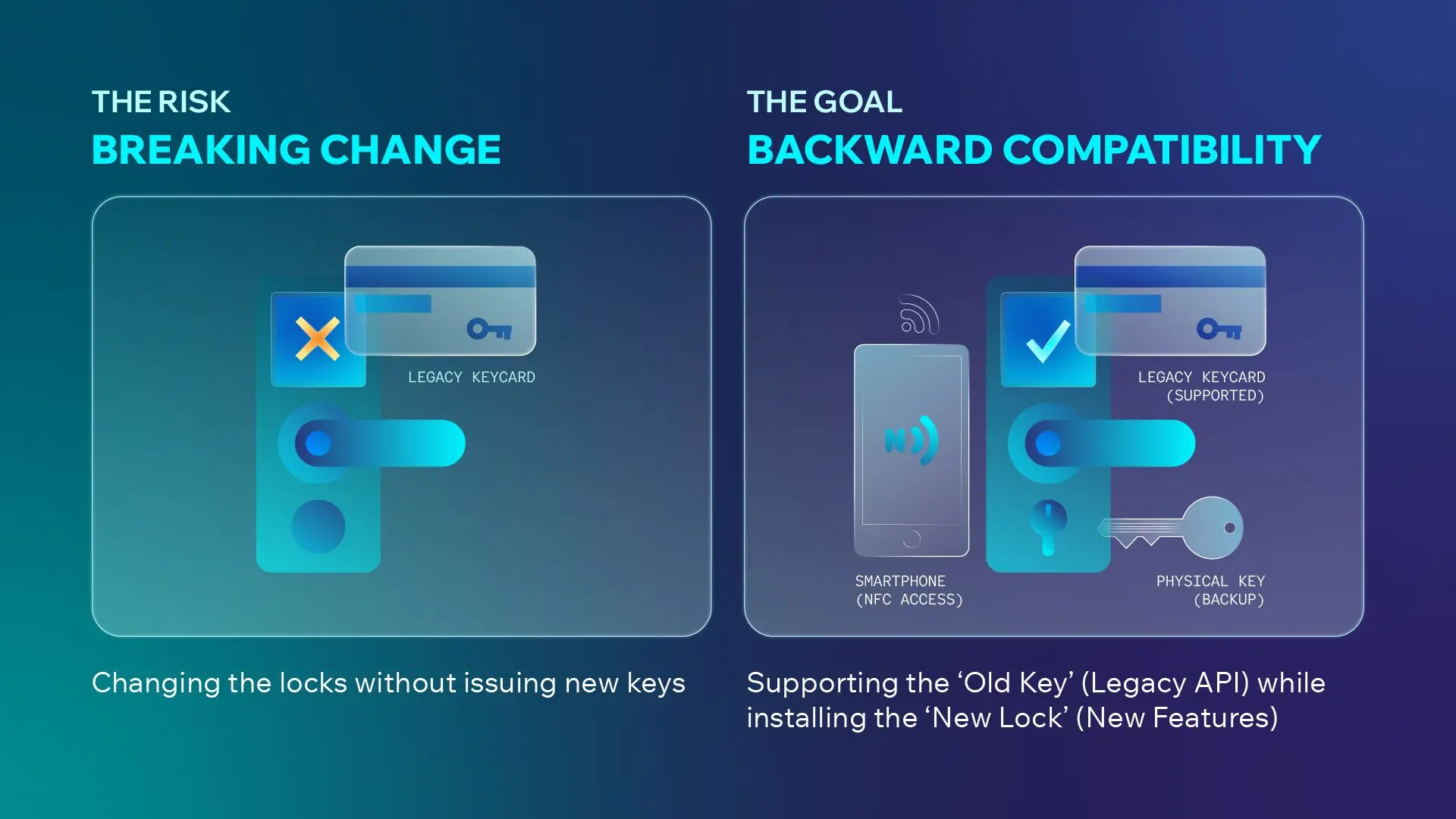
Think of it like a hotel upgrading its room locks.
A poor upgrade changes the locks without issuing new keys; thus, every guest is locked out overnight. A thoughtful upgrade supports the old keycard, the new NFC phone tap, and a physical backup key simultaneously. Guests never notice that the upgrade happened.
That’s the goal.
Every "simple" API change has the potential to ripple through a complex ecosystem, impacting billing systems, mobile apps, reporting pipelines, and third-party integrations. So, when we fail to maintain this compatibility, we expose the organization to three critical tiers of risk:
-
Financial Risk: Disrupting revenue flow and triggering SLA penalties.
-
Legal Risk: Potential breach of contract terms regarding service stability.
-
Operational Trust: Every breaking change forces teams to divert resources from their core mission to fix what was already working.
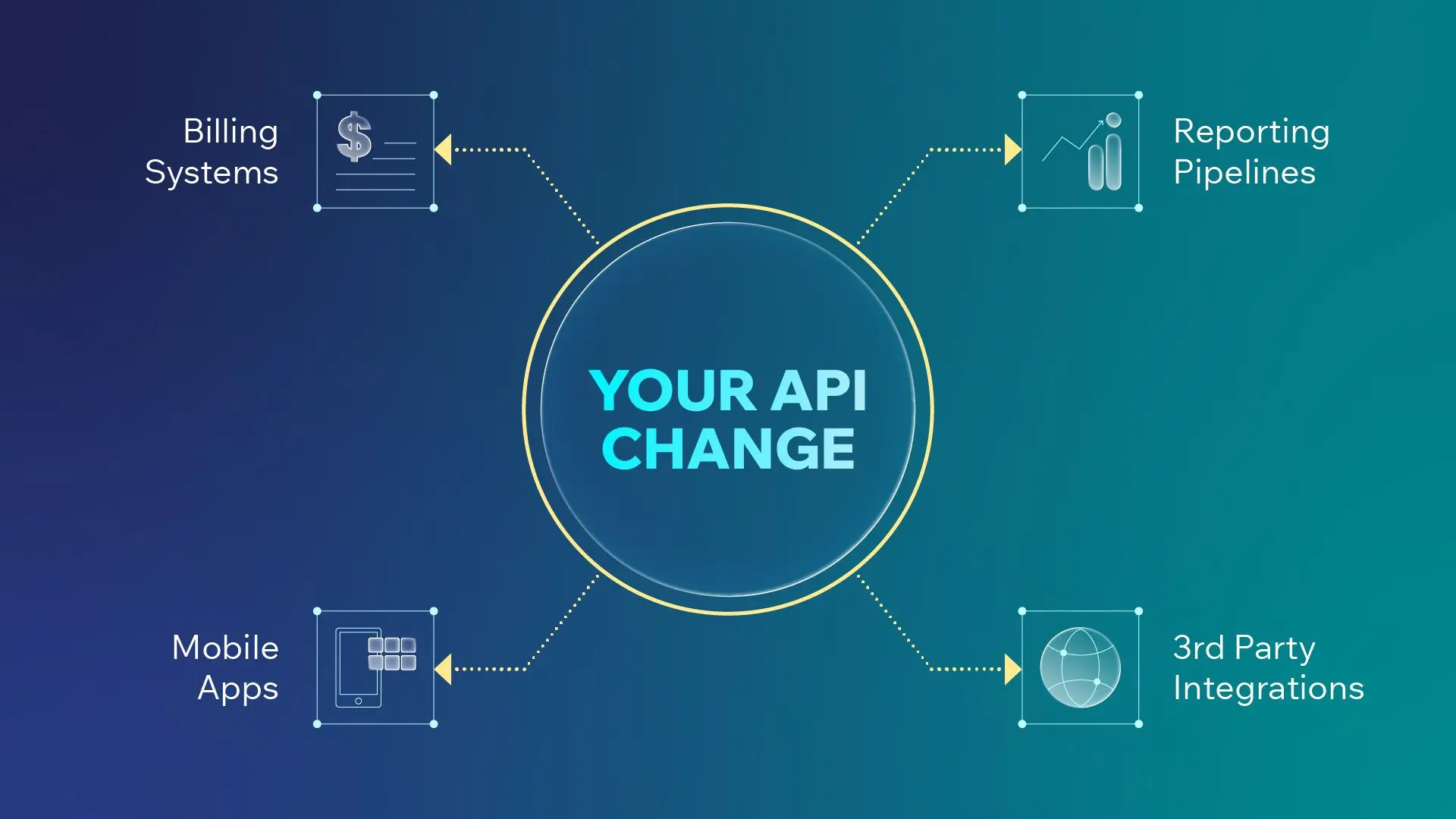
In short, backward compatibility isn't about freezing a product; it’s about evolution without extinction, allowing clients to migrate to new features on their own schedule rather than ours.
Evolution Without Extinction: Key Principles
To maintain trust while evolving a product, leaders should champion three core architectural philosophies:
1. Build Systems that Accept Gracefully and Output Precisely
Postel’s Law, “be conservative in what you send and liberal in what you accept”, is the golden rule of distributed systems. It’s what allows systems to remain stable as client environments change around them.
2. Add, Never Remove
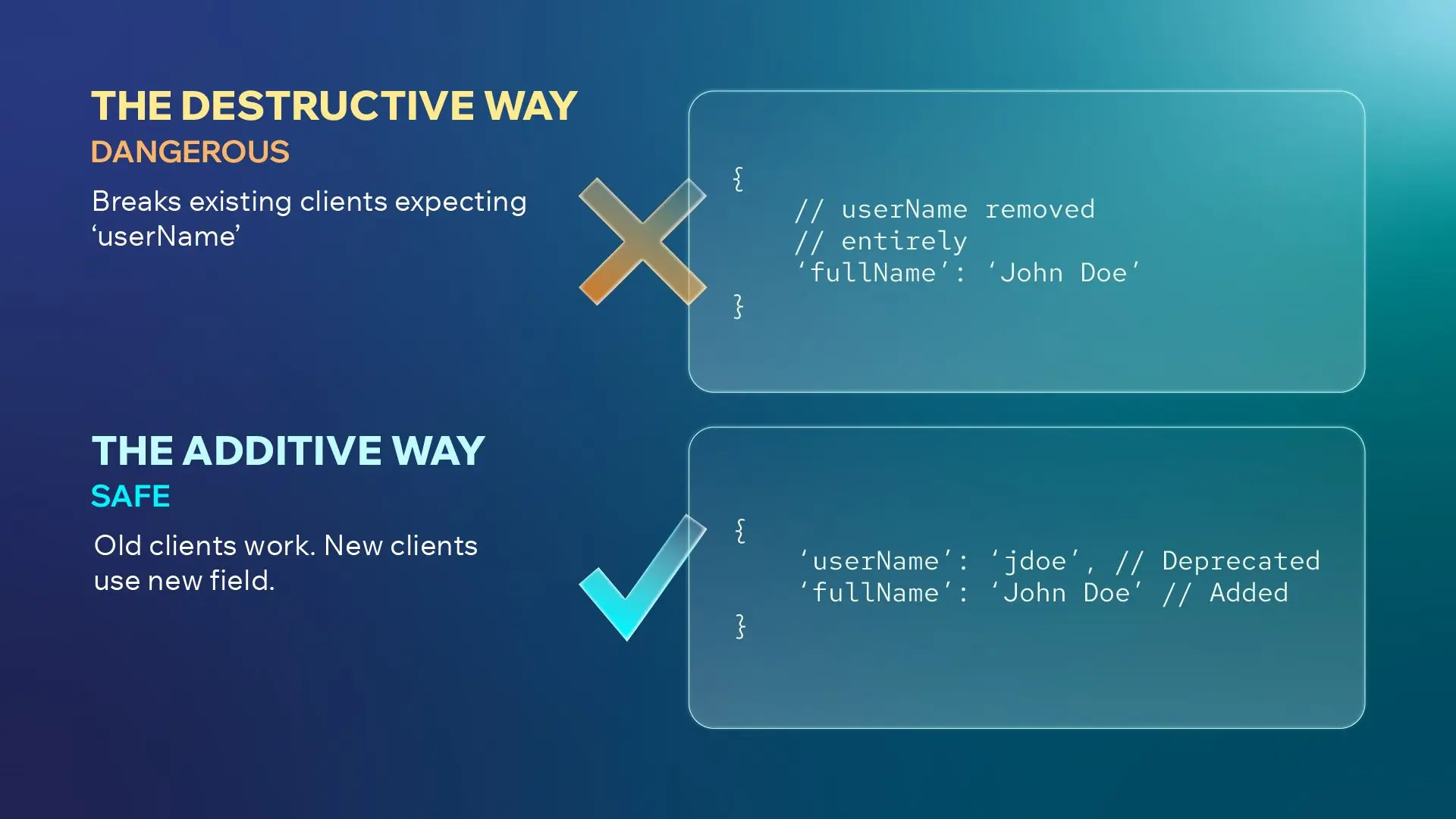
Removing a field (like a userName) breaks existing clients; adding a new field (like fullName) while keeping the old one allows old and new clients to function side-by-side.
-
Optional > Required: New fields should never break existing validation logic.
-
Deprecation over Destruction: Think of it as adding lanes to a highway rather than rerouting traffic.
3. Forward Recovery over Rollbacks
-
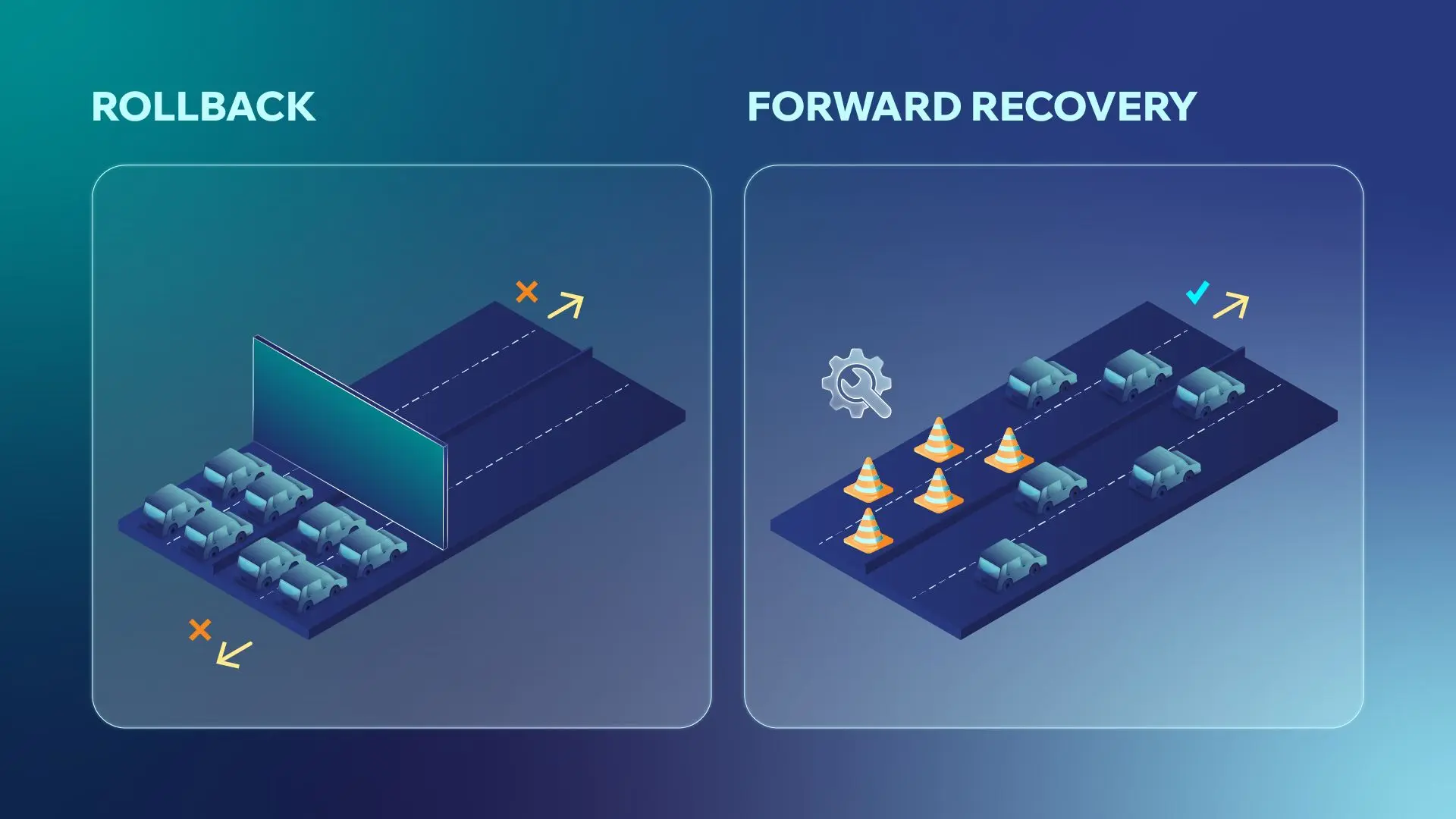
Rollback: Reverting to a previous state. This can lead to "data orphans" and significant manual cleanup.
-
Forward Recovery: Fixing the issue in place or bypassing the failure while remaining online.
Forward recovery prioritizes data integrity over code simplicity. By "failing forward," such as allowing systems to accept both old and new security tokens, you avoid "mass logout" events and service disruptions. This transforms a potential crisis into a seamless background update.
The Traffic Light Protocol for Change Management
Enterprises do not fear change; they fear unannounced change. A simple traffic light model gives every team a shared language for managing releases.
| Signal | Impact | Protocol |
|---|---|---|
| 🟢 Safe | Invisible to clients | Deploy freely. Additive updates, no communication required. |
| 🟡 Transitional | Deprecation Phase | Warn via headers and logs. Old behavior still works. Give clients a clear migration window. |
| 🔴 Breaking | Major disruption | Rare, explicit, and jointly planned with clients. Never a surprise. |
Managing Exposure with Feature Flags
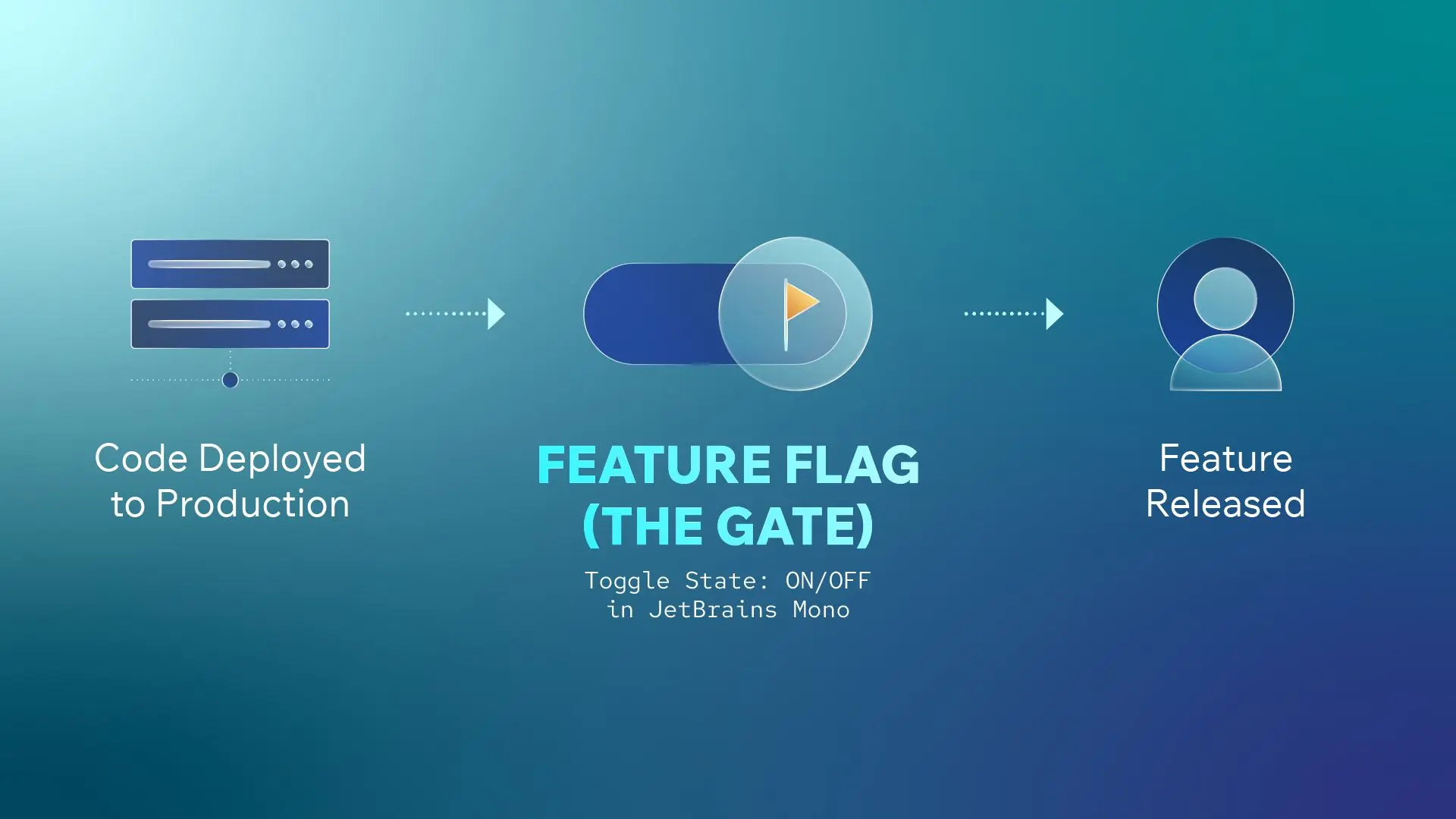
The most mature engineering organizations have separated deployment from release entirely. Feature flags, sometimes called “the gate”, let code reach production without activating for all users, giving teams three critical controls:
-
Targeted Release: Expose a new feature to 5–10% of users first, not 100%.
-
Early Detection: Monitor error rates before they become incidents.
-
Instant Kill Switch: Flip the flag off. Zero downtime, zero rollback complexity, zero client impact.
This transforms release risk from a binary bet into a controllable dial. It’s one of the clearest indicators of an engineering organization that has operationalized stability rather than just aspired to it.
Conclusion: Protecting Business Continuity
Backward compatibility is ultimately a matter of Trust, Stability, and Communication. By treating compatibility as a strategic asset, we stop relying on "Big Bang" releases and start managing exposure to ensure our clients' business continuity remains uninterrupted.
If your team is navigating a complex API migration, deprecating legacy interfaces, or trying to build release discipline at scale, this is exactly the kind of challenge we help engineering leaders solve.
Let’s talk about what “evolution without extinction” looks like for your organization.
Duc K. Nguyen
Software Engineer
Duc Nguyen is a Full-stack Developer with over 4 years of experience, specializing in back-end development using JavaScript, Typescript, and Java, along with their modern frameworks. He has hands-on experience building applications from the ground up, contributing to system architecture, designing system implementation, and performance optimization across a wide range of domains, from enterprise platforms to large-scale, high-complexity trading systems.